Block Placement Puzzles
How it works
Block placement puzzles hand you a grid and a small set of shapes. You place each shape anywhere it fits, without overlapping anything already on the board. When you fill an entire row or column, that line clears and the space opens up again. You keep going until none of the shapes you are holding will fit, and then the round is over.
Unlike falling-block games, nothing here moves on its own and no timer pushes you along. The challenge is purely about space. Many games in the genre give you a few pieces at once and only refill them when all are used, so you have to plan around shapes you are stuck holding. Some let you rotate pieces; others leave rotation out on purpose to keep decisions crisp.
What makes a good one
- A board small enough to read at a glance and big enough to make choices matter.
- A clear, fair set of shapes, so you can learn them and plan around them.
- Clean feedback when a line clears, so you always know why you scored.
- No hidden timers. A spatial puzzle should reward thinking, not speed.
Strategies that help
Look at the whole hand. Decide the order for all your pieces before placing the first one.
Place awkward shapes early. Long bars and big corners are easiest to fit while the board is still roomy. Save the small pieces for patching gaps.
Protect an open area. Keeping one large empty patch gives bulky pieces somewhere to land when they show up.
Avoid lonely holes. A single empty square boxed in on all sides can only be filled by the smallest piece, and you may never get one.
Our take
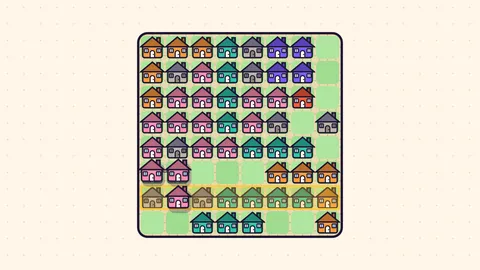
Tiny Grid Daily is our take on the genre. Pieces are little house blocks on an 8x8 board, full lines mean residents moving in, and there is no rotation. Everyone gets the same town and 36 pieces each UTC day, with a shareable emoji result, and Endless keeps going until nothing fits. You can play it now. If you would rather fill every gap exactly than clear lines, see packing puzzles.