Packing Puzzles
How it works
A packing puzzle gives you a space and a set of pieces, and asks you to fit all of them in exactly. Every cell gets filled, nothing overlaps and nothing hangs over the edge. Unlike games where full lines clear and the board empties again, nothing disappears here: the puzzle is finished at the moment the last gap closes. Because there is always at least one perfect arrangement, the challenge is finding it, not surviving a stream of random pieces.
Some packing games let you turn pieces; others leave rotation out so every decision is simply where a piece goes. Without rotation, mirror twins become the interesting part: two shapes that look alike but only fit opposite corners.
What makes a good one
- Every puzzle has a solution, checked before you ever see it.
- Clear feedback while you drag, so you know whether a piece fits before you let go.
- Free undo, because trying ideas is how you learn a packing puzzle.
- A steady curve: new kinds of space or piece arrive slowly, with easier breathers in between.
Strategies that help
Awkward shapes first. Long pieces and odd corners fit easily into an empty space and hardly ever into a crowded one.
Fill corners and edges early. A corner accepts only a few shapes. Decide what goes there before you fill the forgiving middle.
Count the cells. If a gap holds three cells, only a piece of three cells, or a combination that adds up to three, can fill it.
Keep the small pieces for last. Single squares are the most flexible pieces you have. Spend them on the final odd gaps.
Check for twins. When two mirror shapes are in the set, work out which side each one needs before placing either.
Our take
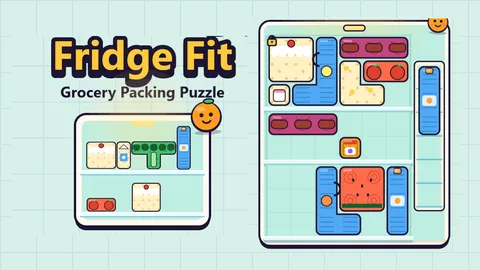
Fridge Fit is our packing puzzle. The space is a fridge with glass shelves, a thin door strip and a freezer drawer, the pieces are cartoon groceries that never turn, and every fridge has a perfect fit. There is a ranked Daily fridge with a shareable result. If you prefer clearing lines to filling every gap, see block placement puzzles.